Tampilkan postingan dengan label Therapy. Tampilkan semua postingan

Sabtu, 08 Juli 2017

Anodyne Therapy for Neuropathy


Today's post is from Podiatrytoday.com (see link below) and concerns, Anodyne therapy, a light-therapy treatment for neuropathy that you may have read or heard about. It's one of those things which has lots of claims concerning it's effectiveness but true, evidence based research is more difficult to find. If you feel that it may be something for you and you can afford it (it is generally not covered by insurance policies) then of course it may be worth a try. Remember however, to prepare for possible disappointment. It seems to work for some people but by no means all (something all too familiar for neuropathy patients!)

Is Anodyne Therapy The Answer For Peripheral Neuropathy?
Author: Brian McCurdy, Associate Editor

Peripheral neuropathy is prevalent among people with diabetes and has a strong correlation to the majority of diabetic foot ulcers and diabetes-related amputations. One potential option for helping these patients is Anodyne Therapy, a non-invasive treatment that has garnered praise in clinical studies and anecdotal kudos from podiatrists and their patients.
The device, which received FDA approval in 1994, reduces pain and increases circulation, according to the company Anodyne Therapy. How does it work? The Anodyne Therapy System uses monochromatic infrared energy (MIRE) to release nitric oxide from the patient’s red blood cells. The company says this improves nerve function and is important for making new blood vessels and healing wounds. As the company notes, “low levels of nitric oxide are common in people with diabetes and are a major factor in the poor circulation, loss of sensation, chronic falls, foot ulcers and pain of diabetic peripheral neuropathy.”

The manufacturer also emphasizes that Anodyne Therapy has been clinically proven to increase local microcirculation and reduce pain. It says there are several clinical studies that demonstrate significant clinical outcomes including restoration of protective sensation in patients with diabetic peripheral neuropathy, pain reduction, increased nerve conduction and faster healing of diabetic ulcers and other chronic wounds. Podiatrists also tout the product’s benefits.

What Podiatrists Are Saying
“We actually had very good results,” says Timothy Shea, DPM, a Certified Wound Care Specialist at the John Muir Wound Care Center in Walnut Creek, Calif. “So far, it seems to be a good, proven, acceptable modality which is useful for patients.”
Dr. Shea, an Adjunct Associate Professor at the California College of Podiatric Medicine, has used the Anodyne Therapy System as an adjunct to wound care. One of his patients had peripheral neuropathy that doctors could not diagnose and described his pain level ranging from a 7 or 8 to a 10 with 10 being the most painful. If he undergoes treatment at home, the patient said his pain level dropped to 2 or 3, according to Dr. Shea.
Anodyne Therapy says performing three treatments per week for 30 to 45 minutes in your office and having the patient follow up with a weekly maintenance program at home will yield the best clinical results.
Stephen Barrett, DPM, says some patients who are not surgical candidates for nerve decompression can get relief from the system.
“We’ve had some patients that have had extraordinary results,” says Dr. Barrett, a Fellow of the American College of Foot and Ankle Surgeons.“We’ve also had some patients that have had mixed results. Overall, it’s been a very beneficial thing.”
Dr. Barrett says he also has initial neurosensory documentation with the pressure specified sensory device, which has shown significant improvement in two-point static discrimination after 12 treatments.
Glen Robison, DPM, has used Anodyne Therapy on patients with diabetic neuropathy, plantar fasciitis, ulceration and other problems. After therapy, most patients have said they can feel their feet. He says 90 percent or more of diabetics who use the product find their neuropathic numbness reversed.
“The success was overwhelming,” says Dr. Robison. “I have a steady flow of diabetics and non-diabetics with neuropathy who have greatly benefited.”

Final Notes
The company offers two systems, the Anodyne Model 480 Professional System and the Anodyne Model 120 Home System. The only contraindications are for pregnancy and active malignancy, according to the company.
As far as drawbacks go, Dr. Barrett notes some reimbursement problems with the device and Dr. Robison says insurance companies do not cover it. However, the company notes the device recently received a specific Medicare HCPCS code of E0221 that should facilitate reimbursement from Medicare and other insurance carriers.

http://www.podiatrytoday.com/article/1404

Sabtu, 07 Januari 2017

Can Scrambler Therapy Be A Successful Answer To Nerve Pain


Today's post from foundationforpn.org (see link below) and written by two oncologists looks at one of the most popular new electronic impulse devices for reducing nerve pain - the Scrambler therapy. Their only motive for using this technique that sends non-pain signals along the same nerves that pain signals travel (different to TENS therapy) seems to be in trying to attain some relief for their patients who have neuropathy through chemotherapy treatment. In their own small-scale trials, they achieved significant success using the Scrambler technique. The point is, that in these days when drug treatments for nerve pain have such a bad press, everybody is looking for the best possible, non-drug and non-invasive treatment. Scrambler therapy may just be such a workable option in the future. The problem is, as so often, the cost. The machines are expensive but I would suggest that the cost of a Scrambler machine is far outweighed by the cost of a life long treatment with drugs and medical services for your typical patient with severe neuropathy. Scrambler therapy already exists, so further trials and research on larger groups seem to me a no-brainer. That said, other electrical implant therapies for nerve pain have been shown to be less than consistent in their results but then again, you could say that for every single neuropathy treatment you can imagine!


Scrambler Therapy for Treating Neuropathic Pain
December 9, 2016 by Dr. Thomas Smith and Dr. Charles Loprinzi
 

What is neuropathic pain, from the non-expert oncologist’s point of view?

The way we think of it, pain is about the most protective instinct and impulse known to humans! If you touch a hot plate, you retract your hand even before you actually feel the pain. Then, the pain comes – very localized – such that you can plunge the hand into cold water. After that, usually the pain goes away and you can then blame your son-in-law for leaving the hot plate on. But sometimes, the pain signal gets stuck in the “on” position, even though your hand has healed. There has been some damage to the nerve endings, and they are continuing to send the “pain” impulse when it is not doing you any good. The pain pathways in the spinal cord and the brain actually get bigger and more active; neurologists call this “wind-up.”

Pain has come to the attention of most oncologists because we CAUSE it with chemotherapy agents; we call it chemotherapy induced peripheral neuropathy (CIPN).

For the unfortunate 40-70% of chemo patients who get CIPN, it can range from being a nuisance to being life-destroying. Our patients describe constant burning or pins-and-needles pain, with numbness and tingling. It starts in the longest nerves that go to the hands and feet first, then progresses upstream. For many people it is just an inconvenience, and goes away in between chemo cycles and abates after treatment. But for others it persists, for years.

Preventing or treating CIPN has been frustrating. We both were part of the American Society of Clinical Oncology panel that made national clinical practice guidelines for CIPN. There are no drugs proven to prevent it, and alpha-lipoic acid, Vitamin A, natural products, L-carnitine – things that help in other neuropathies – were no better than placebo. Only one drug is proven to help, duloxetine (Cymbalta), with a reduction in pain of about 1 point on a 10 point scale.

Of course, there are other neuropathic pains that oncologists know all too well. The pain from a pinched nerve leaving a collapsed or damaged vertebra, shooting down the leg. The pain after shingles, “post-herpetic neuropathy” that can last for years. The pain after chest surgery, or mastectomy, or radiation.


What is Scrambler Therapy, and How Does it Work?

Scrambler Therapy (marketed as Calmare™ therapy in the United States) is a new type of pain relief that uses a rapidly changing electrical impulse to send a “non-pain” signal along the same pain fibers that are sending the “pain” stimulus. We got interested in Scrambler Therapy because we thought it MIGHT help CIPN patients, and Scrambler Therapy appeared to be non-toxic. It had been cleared for safety by the FDA in 2009.

We were skeptical, but we did a trial of Scrambler Therapy. We treated 16 patients with refractory CIPN (present for at least 6 months, and refractory to medications); the group had a 60% reduction in their CIPN pain – in 10 days of treatment. Of the 16 patients we treated, essentially all reported some benefit, including 4 whose pain resolved to “0.” Function improved in most patients including less interference with walking and sleeping, for at least 3 months.

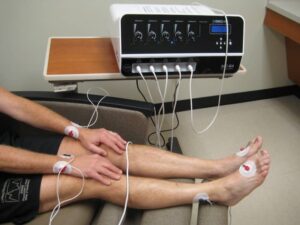
The setup is simple as shown in Figure 1 (Tom Smith’s legs). EKG electrodes are used to transmit the electrical impulses from a colored electrode to a black one, back and forth. The treatment is given for 30-45 minutes for up to 10 days in a row (excluding weekends). Our patients report a feeling like being bitten by electrical ants, or bee-stings. If the treatment is working, the sensation will change to a “hum” in the nerve and go to the ends of the nerve. We have to start above the painful area – remember, we are trying to replace the pain with a “non-pain” stimulus, and sometimes can work progressively down the legs and arms as pain relief occurs.


Figure 1: A typical setup to treat “stocking and glove neuropathy”

Colleagues at Mayo Clinic were skeptical and repeated the study in a larger group of people with CIPN. Pachman, Loprinzi and colleagues at Mayo reported about a 50% reduction in pain, numbness and tingling lasting at least 3 months. Of note, there appeared to be a learning curve, with the later patients getting better and longer lasting pain relief.

We will be the first to note that Scrambler Therapy lacks the “Good Housekeeping Seal of Approval” of cancer treatments – the well-designed, large, high statistical power, randomized controlled trial. We are both doing randomized trials, comparing Scrambler Therapy to “sham” (electrodes in the wrong place” and to TENS (trans-cutaneous electrical stimulation).

That said, we are interested in treatments that might work and don’t cause side effects. A recent review of at least 20 scientific reports noted no harm in any trial, with most reporting a substantial relief of pain. The two randomized trials comparing “sham” to real Scrambler Therapy showed a 50% reduction in low back pain, and a 91% reduction in pain from failed back syndrome, post herpetic neuropathy, and spinal cord stenosis. In all the trials, pain relief – if it happened – was obvious in the first 3 days, continued to get better, and usually lasted several months. There are additional reports of Scrambler Therapy having success in cancer somatic pain including bone and visceral metastases, complex regional pain syndrome, pediatric cancer chest wall pain, and others (see list below). The US Military has 17 Scrambler Therapy machines for treating both wounded warriors and civilians.

Some types of pain for which Scrambler Therapy has been used
Pancreas and abdominal cancer pain
Chemotherapy induced peripheral neuropathy
Non cancer pain such as neuropathic back pain
Post-herpetic pain (shingles pain)
Bone metastases
Spinal cord stenosis
“Failed back syndrome” – after surgery, the back hurts worse
Complex regional pain syndrome
Post-mastectomy pain 


Is Scrambler Therapy Related to Anything Similar?

Scrambler Therapy looks superficially likes TENS therapy. TENS applies similar electrodes on the skin and passes a pulse of electrical current between them. TENS is a completely different type of on-off current, and, classically, the effect wears off as soon as the electrodes are removed. When Scrambler Therapy works, it seems to reset or reboot the system for an extended period of time.

Spinal cord stimulation appears to have a same effect on pain that Scrambler Therapy appears to have. However, it involves putting electrodes on the spinal cord, and implantation of a pulse generator, similar to a pacemaker. It is also expensive – typically near $100,000 for a trial, then surgery and the equipment. It can last for years.


Is Scrambler Therapy Covered by Insurance?

Quick answer, no, not very well yet. They are waiting for more traditional evidence (unlike the U S Military!) Some places are doing it for free on the clinical trials listed on clinicaltrials.gov. There is a list of certified centers on the Calmare website. An increasing number of insurers are paying for Scrambler if the person and their doctor appeals with lots of evidence from the trials above.

The machines themselves are expensive ($105,000 was the last quote we got) but can be used for a new person each hour, and last for years. The electrodes cost $4-15 dollars per person for a course of treatment. A person with training can do the treatment supervised by a physician with knowledge of the nervous system.


What research needs to be done before Scrambler Therapy is proven effective, and reimbursed if it is?

We have been using Scrambler Therapy routinely at our centers, and believe there is benefit to some patients. At the same time, we are humbled by the many therapies that have shown promise in phase II trials only to be no better than placebo or sham in Phase III trials. We need bigger randomized trials, sponsored by the NIH or someone who is not trying to sell the machines.

Dr. Thomas Smith is the Director of Palliative Medicine, Harry J. Duffey Family Professor of Palliative Medicine, Johns Hopkins Sidney Kimmel Comprehensive Cancer Center

Dr. Charles Loprinzi is Regis Professor of Breast Cancer Research, Mayo Clinic

https://www.foundationforpn.org/2016/12/09/scrambler-therapy-for-treating-neuropathic-pain/

Minggu, 07 Agustus 2016

Can Cognitive Behavioural Therapy Help With Neuropathic Pain


Today's post from kcl.ac.uk (see link below) talks about a new research study into the psychological and physical effects of HIV-related neuropathy. It aims to encourage psychological treatments via the internet, for people who aren't responding very well to the standard treatments. It's based on the premise that new cognitive behavioural therapy may help people to respond better to the pain. It began in January of this year but is still taking on people who are interested in joining the study. It's a laudable mission and who knows; if these methods work, they could also work for other people with chronic pain issues from neuropathy - there's no reason why this group should be exclusive. Further details below.

The OPEN Study
King's College London 2016
 

Online Psychological Treatment for People with Painful HIV-related Peripheral Neuropathy (The OPEN Study)

The OPEN study aims to understand how people with HIV and pain in their feet cope with this pain, and to develop and test a new psychological treatment approach to manage the impact of this pain on people’s lives.

Why are we doing this study?
Many people with HIV experience pain in their feet due to peripheral neuropathy, which may be related to HIV or its treatments. This pain is often not relieved by medical treatments.
Psychological treatments, such as cognitive behavioural therapy (CBT), have been shown to help improve functioning and quality of life in people with chronic pain. However, little is known about whether CBT is helpful for people with HIV and peripheral neuropathy.
It can be difficult to access CBT for managing pain, so we are working to develop a version of CBT delivered over the internet to increase the availability of this treatment for people with HIV and peripheral neuropathy.
What are we doing?

Part 1

Starting January 2016: We are undertaking a systematic review of the evidence about psychological factors (e.g., depression, anxiety, thinking patterns, coping behaviours, social support, etc) associated with chronic pain in people living with HIV. This review will help us identify factors that are important to consider within CBT for people with HIV and peripheral neuropathy.

See a summary of the protocol for this review at the PROSPERO website,

Part 2 - Now recruiting participants

From November 2016 to June 2017 we will conduct interviews with approximately 30 people living with HIV and peripheral neuropathy.
The interviews will ask people how they cope with pain, and their thoughts on a version of CBT delivered over the internet.
If you would like to participate in this study please see the recruitment advertisement and participant information sheet for more details.

Part 3 

We will develop the new online CBT for people with HIV and peripheral neuropathy based on data gathered from the systematic review and interview study.
We will ask people living with HIV and peripheral neuropathy to provide feedback on the new treatment once developed.
From May 2018 – August 2019 we will conduct a small randomized controlled trial comparing the new online CBT to a control group to see how satisfied people are with this treatment and whether it is feasible to do a larger study. Approximately 70 participants with HIV and peripheral neuropathy will be recruited for this study.

Funding Ethics Study team Contact us


Please contact Dr Whitney Scott if you would like to know more about the OPEN Study:

Whitney Scott, PhD

NIHR Postdoctoral Fellow

Health Psychology Section

Institute of Psychiatry, Psychology, and Neuroscience

King's College London

5th Floor Bermondsey Wing, Guy's Campus

London SE1 9RT

Email: whitney.scott@kcl.ac.uk

Tel: 020 7188 5421

http://www.kcl.ac.uk/ioppn/depts/psychology/research/ResearchGroupings/healthpsych/research-group/The-OPEN-study.aspx